The Forever Child: Why AI Can Change the World and Still Be a Terrible Investment
The world is full of AI super-fans
But as an investment, perhaps we should not look at historical milestones like the internet and assume AI will follow the same path.
AI likely won’t.
The internet was largely an infrastructure upgrade for human communication. This had been done many times before with fire, flags, pony express, telegrams, phones and the internet was better but part of an evolution. And not altogether different as a business model.
AI is trying to do something entirely different. AI wants to be a silicon version of RI (Real Intelligence). But what if intelligence does not behave like a normal product?
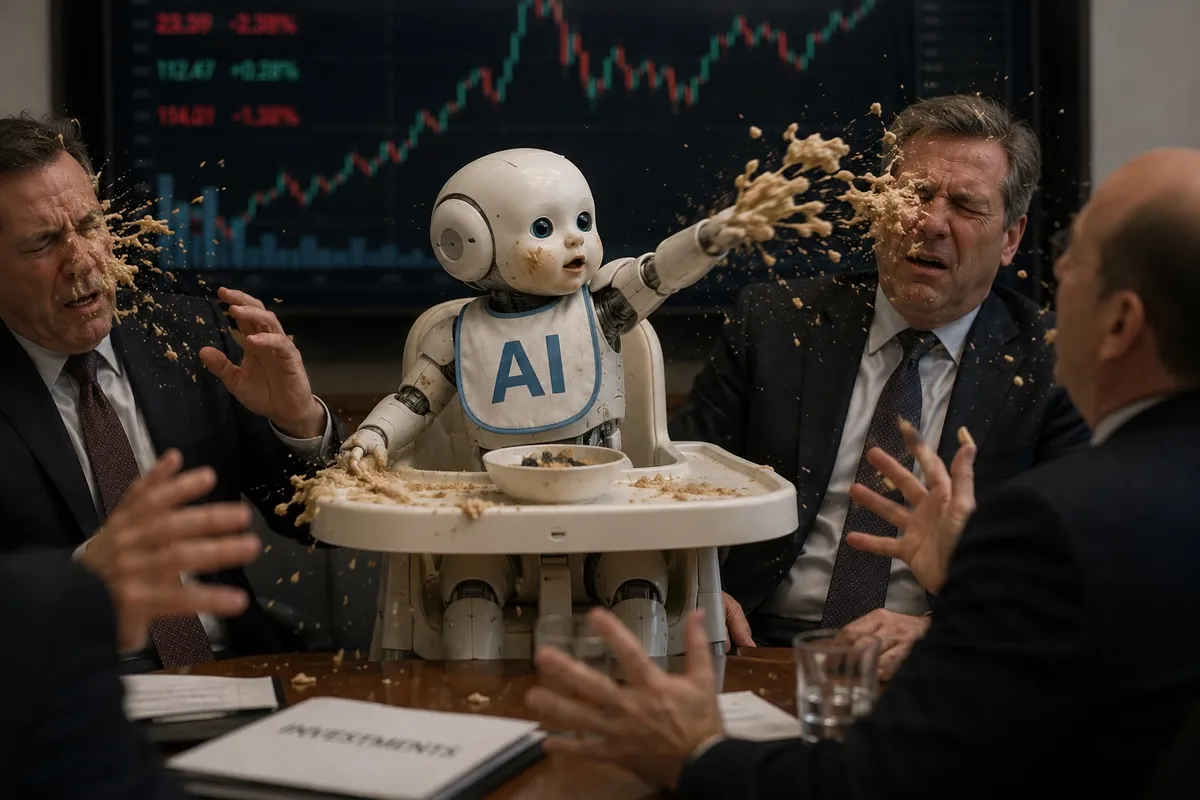
To understand the potential economic trap of AI, imagine funding a brilliant but uncontrollable child. The child learns astonishingly fast. Every year it becomes more capable and more valuable. But it is never finished.
As the child grows more intelligent, it needs more. More education. More information. More energy. More expensive teachers. Access to knowledge at the very edge of human understanding. And every new ability creates astonishment in the parents and demands for more from the child.
There may never come a moment when you can declare the child complete, stop investing, and simply collect the profits.
That is the economic problem that may be hiding inside artificial intelligence. Private capital works beautifully when there is a recognizable arc: invest heavily, build the product, scale it, drive down the marginal cost, and harvest the profits. But what if AI’s arc is different? Invest heavily. Make it smarter. Create new expectations. Feed it more information. Build more infrastructure. Make it smarter again. Repeat forever.
AI could transform civilization while remaining an awkward, or even irrational, asset for private capital to finance indefinitely. Its value to society may become enormous while the cost of keeping it current, improving it, and satisfying ever-rising expectations never truly levels off.
The Reality Check: Wall Street’s “Apple Standard”
Before getting to the deeper problem, it is worth considering just how much future success investors have already priced into the companies building the AI economy. The following is intentionally back-of-the-napkin math. Market valuations change every day. Revenue periods do not line up perfectly. A mature company like Apple is not directly comparable to a fast-growing AI company. And a private funding valuation is not the same thing as a public market capitalization.
This is not an argument that AI companies should be valued like Apple today. It is a more generous thought experiment. Apple is one of the most efficient and profitable businesses ever created. As of early July 2026, the market values it at roughly $4.3 trillion against approximately $451 billion in annual revenue.
In very rough terms, investors are valuing Apple at about $9.50 for every dollar of annual revenue. So let us assume, perhaps implausibly, that some of the companies at the center of the AI economy eventually become that good.
What would they need to earn?
NVIDIA, valued at roughly $4.8 trillion, would need about $500 billion in annual revenue to trade at Apple’s revenue multiple.
SpaceX, at roughly $2.3 trillion, would need about $240 billion.
Anthropic, valued at approximately $965 billion, would need about $100 billion.
OpenAI, valued at roughly $852 billion, would need about $90 billion.
Combined, those four companies would need to generate approximately $930 billion in annual revenue to justify their current valuations at Apple’s own multiple. Apple itself generates about $451 billion.
In other words, just four of the companies most exposed to today’s AI boom would eventually need to produce combined annual revenue equal to roughly two Apples, even if we generously assume they become as efficient as one of the most successful businesses in human history. And that is before widening the lens.
Microsoft, Alphabet, Meta, Amazon, Broadcom, Oracle, and much of the surrounding chip, cloud, energy, and data-center economy now carry valuations influenced to varying degrees by expectations about AI.
It would be dishonest to assign all their market value to artificial intelligence. These are enormous companies with enormous non-AI businesses.
But it would be equally strange to pretend that none of the trillions of dollars added to the AI-exposed market reflects expectations about what AI will eventually earn.
Widen the lens beyond the four companies above, and the question becomes difficult to avoid:
How many more Apple-comparable revenue streams must the AI economy somehow create? Three? Four? Five?
No one can calculate that number precisely because no one can cleanly separate the AI premium from the rest of the market.
But that uncertainty is itself revealing.
Investors have already committed trillions of dollars to a future in which the AI economy does not merely become large. It must create several new Apple-sized rivers of revenue that do not yet exist.
The market has priced these companies as if the child has already grown up and built a collection of trillion-dollar businesses.
But the child is still in school.
And the tuition bills may never stop.
The Leaky Bucket of Consumer Subscriptions
To support these valuations, the AI economy needs more than excitement. It needs customers who keep paying.
That is proving more difficult.
According to RevenueCat’s 2026 subscription-app data, AI applications are often good at getting users to pay. Keeping them paying is another matter.
Among monthly consumer subscribers, AI apps retained only about 6.1 percent after 12 months, compared with 9.5 percent for non-AI apps. Annual AI subscriptions also underperformed, retaining about 21.1 percent of subscribers compared with 30.7 percent for non-AI apps.
The exact percentages matter less than the pattern.
AI can be astonishing without yet being indispensable.
Many consumers try an AI product, marvel at it, pay for it and then leave. Why?
Some discover they do not have a daily need that justifies another monthly subscription. Others find that getting consistently useful results takes work. AI can hallucinate. Different models contradict one another. Good results often require supervision, experimentation, and learning how to use the tool itself.
Corporate adoption appears more promising. When a company integrates AI into a software-development pipeline, research process, or customer-service operation, the tool can become part of the infrastructure itself. The financial returns can be real. But even there, the larger question remains.
Can enterprise revenue grow large enough, and fast enough, to support the extraordinary expectations now spread across the entire AI economy?
Does the market of non-AI companies even have the free cash flow, or will it, to fund another three or four Apple-sized revenue streams?
The Bottomless Pit of Ongoing Costs
This brings us to the core financial problem.
Intelligence may not scale like traditional software.
When a dot-com company built a website, the cost of allowing one additional person to view a page could eventually become almost trivial. Once the software was written, millions of people could use essentially the same code.
AI is different.
Every AI interaction requires fresh computation. The most capable models can require enormous amounts of it. Chips run. Electricity is consumed. Data centers must be built and cooled. Expensive hardware can become economically obsolete at extraordinary speed.
The industry is making remarkable progress in efficiency. Yesterday’s intelligence will almost certainly become cheaper.
But there is a catch.
Every time AI becomes more capable, we ask it to do something harder.
A cheaper model that writes an email does not end the investment cycle. We ask the next model to write software. Then conduct research. Then design drugs. Then reason longer. Then process video. Then operate continuously as an agent.
Efficiency may make yesterday’s intelligence cheaper. But yesterday’s intelligence is not what investors are paying trillions of dollars for. They are paying for tomorrow’s.
The Great Harvest May Only Happen Once
Today’s AI systems have also enjoyed an extraordinary advantage that may be impossible to repeat. They arrived after humanity had already spent thousands of years creating knowledge. Books. Scientific discoveries. Newspapers. Computer code. Legal decisions. Art. History. Manuals. Websites. The accumulated intellectual output of billions of human lives. It was all sitting there waiting to be harvested.
That enormous inheritance may have created a misleading picture of how cheaply artificial intelligence can continue to improve.
The past was already there.
The future is not.
Once AI has absorbed most of the useful knowledge humanity has already created, new knowledge arrives only as fast as human beings can produce it. And the newest knowledge may be the most expensive knowledge to obtain.
It increasingly lives behind journal paywalls, inside private companies, in proprietary databases, in laboratories, in government systems, and in the minds of experts who have not yet published what they know.
An AI trained on history can harvest centuries at once.
An AI expected to remain current must harvest tomorrow one day at a time, forever. And staying current may become more expensive, not less.
The closer AI gets to the frontier of human knowledge, the less there is waiting freely on the internet to be scraped. Frontier knowledge must be discovered, purchased, licensed, verified, observed, or created.
The first great leap in AI came partly from inheriting the accumulated intellectual wealth of human civilization. Future leaps may require paying the full cost of creating what comes next. The Great Harvest only happens once.
Why the Dot-Com Comparison May Fail
This is why the comforting comparison to the dot-com crash may be wrong. The internet made intelligence cheaper to distribute. AI is trying to manufacture intelligence. And manufacturing intelligence may be expensive forever.
When the world laid fiber-optic cable, nobody seriously doubted whether information could travel through it. The challenge was building enough infrastructure and discovering what people would do once connected.
AI carries a deeper uncertainty.
We know that large language models can produce astonishing results. We also know they can hallucinate, contradict themselves, fail at seemingly simple tasks, and require human supervision.
What we do not know is whether today’s approach, more chips, more electricity, more data, better algorithms, and larger systems, ultimately leads to the kind of reliable machine intelligence already embedded in today’s expectations.
Perhaps it does. But perhaps intelligence has no finish line.
Perhaps the child never graduates.
Who Can Afford to Keep Raising It?
Many analysts predict an “AI winter,” a sharp market correction in which overhyped valuations fall and capital spending slows.
But if the argument in this article is right, the more interesting possibility is not that AI fails. It is that AI succeeds spectacularly while its current financing model fails.
AI may transform medicine, software, science, education, government, and nearly every other part of human life. But private capital expects something in return.
Eventually, the investment is supposed to mature. The spending is supposed to slow. Margins are supposed to widen. The parents are supposed to stop paying tuition and start collecting dividends.
What if that moment never really comes?
What if advanced intelligence must be continuously fed, educated, updated, powered, and rebuilt? What if every increase in capability simply creates demand for the next, vastly more expensive one?
Then AI may eventually require a different kind of financial structure.
Perhaps parts of it become public infrastructure. Perhaps governments fund frontier systems the way they fund basic science, highways, or national laboratories. Perhaps sovereign funds, universities, international consortia, corporations, and private users all support different layers of intelligence.
Perhaps the model has not been invented yet.
The point is not that government will inevitably take over AI.
The point is that we should not assume a technology this strange must ultimately fit inside the familiar economics of a private software company. AI may be the most valuable thing humanity has ever built. That does not necessarily mean owning the company that builds it will be a good investment.
The child may change the world. But it also may be a failure to launch.
The question is who can afford to keep raising it?
~David Henson, Citizen Octopus
About the Author
David Henson is an inventor, publisher, writer and founder of Citizen Octopus, a site focused on analyzing systems, incentives, and how information shapes perception.