Congress vs. The Presidency: Mano a Mano
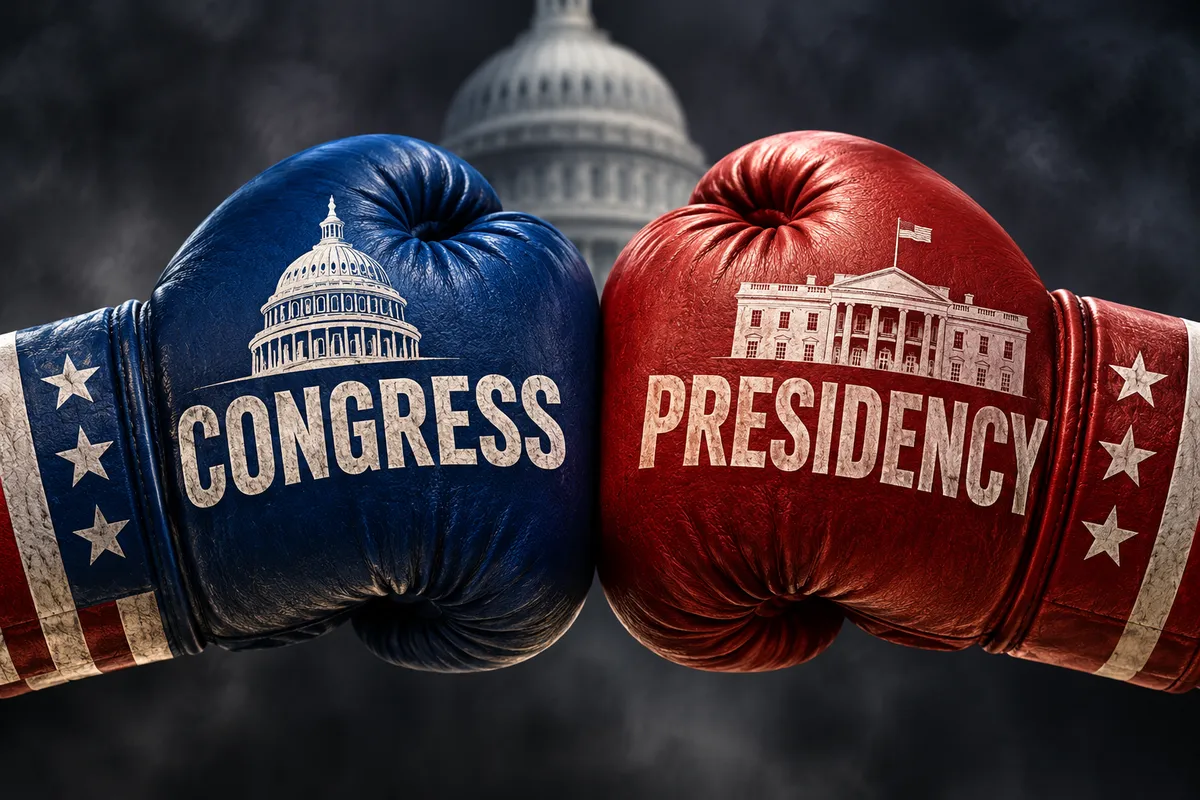 We are about to witness something quite different from the typical gridlock of modern Washington.
Following the historic midterm results that handed both chambers of Congress to the Democrats, the conventional wisdom suggests the standard script: legislative standstill, mutual recriminations, and a slow crawl toward 2028. But that script assumes an institutional framework that no longer exists.
During the first Trump administration, the friction of divided government was heavily muted by an internal, quiet buffer. A long-serving, non-partisan federal bureaucracy operated as an institutional mattress, absorbing executive impact and, in many cases, slow-rolling policies the opposition despised. When Congress wanted to know what was happening inside an agency, a network of sympathetic career civil servants would quietly provide the details.
That inside track is gone. The second Trump administration systematically dismantled it—using sweeping personnel overhauls to convert key policy positions into at-will roles, effectively clearing house and entrenching a hyper-loyal staff.
The mattress has been removed from the boxing ring. What remains is a raw, direct power struggle between two co-equal branches of government. It is mano a mano.
Back to the Spoils System
In that sense, the current restructuring may be less a wholly new political architecture than a partial return to an older one. For much of America's first century, federal administration was far more closely tied to political leadership. The independent professional civil service emerged only gradually after the Pendleton Act of 1883, which sought to end the "spoils system" and insulate the daily mechanics of government from partisan shifts.
By aggressively rolling back these protections, the administration has fundamentally revived a pre-1883 vision of governance. But the federal government of 2026 bears little resemblance to the modest administrative apparatus of 1826.
What was once a localized contest over a comparatively small number of customs houses and postal clerk offices is now a high-stakes struggle for control of an immense, modern administrative state. The tools of partisan control have returned, but they are being wielded over an apparatus of unparalleled scale.
The Great Downsizing
To understand why the incoming Democratic majority lacks an "inside game" within this executive branch, one only has to look at the sheer scale of the personnel vacuum left behind by the Department of Government Efficiency (DOGE).
According to data compiled by the Office of Personnel Management (OPM) and independent watchdogs, the second Trump administration successfully shed nearly 300,000 federal workers through a combination of targeted mass layoffs, probationary firings, and aggressive "deferred resignation" incentive buyouts.
THE DOGE EFFECT: DEEP AGENCY CUTS
| DEPARTMENT / AGENCY | TOTAL WORKFORCE REDUCTION |
|---|---|
| USAID | ▼ 94.6% |
| DOJ Civil Rights Division (Attys) | ▼ 70.0% |
| Department of Education | ▼ 45.0% |
| Department of the Treasury | ▼ 26.0% |
The downsizing was not uniform; it targeted the very regulatory and enforcement arms that traditional Democrats rely on to protect key platform priorities. The DOJ’s Civil Rights Division lost roughly 70% of its attorneys, over 250 lawyers, leaving core sections like voting rights operating on bare-bones staffing.
Meanwhile, the Department of Education’s workforce was slashed by 45%, and the Office for Civil Rights within it saw its staffing halved as the administration actively moved to wind down the agency. At HUD, the Office of Fair Housing shrank from 31 staffers to just 11.
The result? Democrats are taking over Capitol Hill to find the administrative state thoroughly hollowed out and re-engineered.
The Illusions of Power
In this impending war of wills, both sides are entering the arena with massive institutional weapons, yet both are constrained by a fundamental asymmetry.
Because Democrats do not have allies embedded within the departments to apply internal friction, they must rely strictly on external, constitutional leverage. The incoming majorities are already preparing aggressive economic and policy investigations. But a unified executive branch, staffed by individuals chosen for their loyalty to the executive's mandate, will simply shut the door.
When a congressional committee demands documents, the administration will claim executive privilege. The dispute will not result in a bureaucratic compromise; it will result in a federal lawsuit. The oversight battle will move from the halls of agency buildings straight into the courtrooms.
The Spending Standoff
The truest test of this structural clash will be the power of the purse. Holding both the House and Senate means Democrats technically control the money. They can theoretically defund controversial programs or starve specific administrative priorities.
Yet, an entrenched, ideologically aligned bureaucracy gives the presidency a counter-lever. An agency leadership determined to execute the president's agenda will test the absolute limits of "reprogramming" funds, daring a hostile Congress to take the politically hazardous step of shutting down the entire government to force compliance.
Similarly, while a newly minted Democratic Senate majority creates an absolute bottleneck for permanent cabinet confirmations and judicial appointments, the White House is entirely equipped to bypass the chamber by relying indefinitely on "acting" directors or maximizing recess appointment strategies.
Constitutional Endurance
American politics has long tolerated a certain level of theater, where public political battles are quietly managed by the steady state of permanent departments.
But by shifting the bureaucracy into an extension of political will, the administration has forced a structural clarity. Congress can no longer count on the administrative state to do its resisting for it. If the legislative branch wishes to constrain the executive, it must use its explicit constitutional powers directly, publicly, and continuously.
The next two years will not be defined by quiet resistance or bureaucratic slow-rolling. It will be an open, unyielding test of constitutional endurance - a direct collision between legislative authority and administrative resolve.
~David Henson, Citizen Octopus
About the Author
David Henson is an inventor, publisher, writer and founder of Citizen Octopus, a site focused on analyzing systems, incentives, and how information shapes perception.