Will 2026 Mark the End of Web Templates? Replaced by AI Assisted Web Design
 June 2, 2026
By David Henson | Citizen Octopus
June 2, 2026
By David Henson | Citizen Octopus
The funny thing about the modern web is that it didn't start out looking anything like the modern web.
In the late 1990s, websites were often very creative and artistic. A Halloween product site, for example, could have bats flying across the screen. Glowing buttons. Moving graphics. Navigation was unique to each site and reflected the vision of the designer, this could be beautiful, strange, idiosyncratic, and sometimes baffling. The designers were usually coders and the coders were usually designers. If someone imagined it, it could be built.
But soon everyone and every business wanted a website. Designer coders became in high demand. And then websites became expensive.
Businesses arrived. Development teams specialized. Marketing departments demanded predictable results. Frameworks emerged. Templates took over.
For nearly twenty years, the central question of web design shifted. It was no longer: What website should we build? It became: Which template should we choose?
This wasn't a failure of creativity. It was economics.
Custom coding cost real money. Designers and developers became separate specialties. All unusual features increased budgets and timelines. Most businesses simply couldn't justify the expense of something genuinely different.
So all those designers and coders started building templates. And templates took over because they were affordable. WordPress themes. Shopify themes. Squarespace templates. Millions of websites built from variations of the same handful of layouts. The internet became cleaner, more professional, and in many ways more useful.
It also became a little dull.
There was a secondary consequence few people discuss: bloat. To make templates flexible enough for anyone to use, developers built frameworks capable of supporting countless layouts and features. The result was often a simple webpage resting atop layers of code designed for possibilities that would never be used. The effort to simplify web design frequently made websites more complex beneath the surface. The coding equivalent of buying a Swiss Army knife when you only ever use the blade.
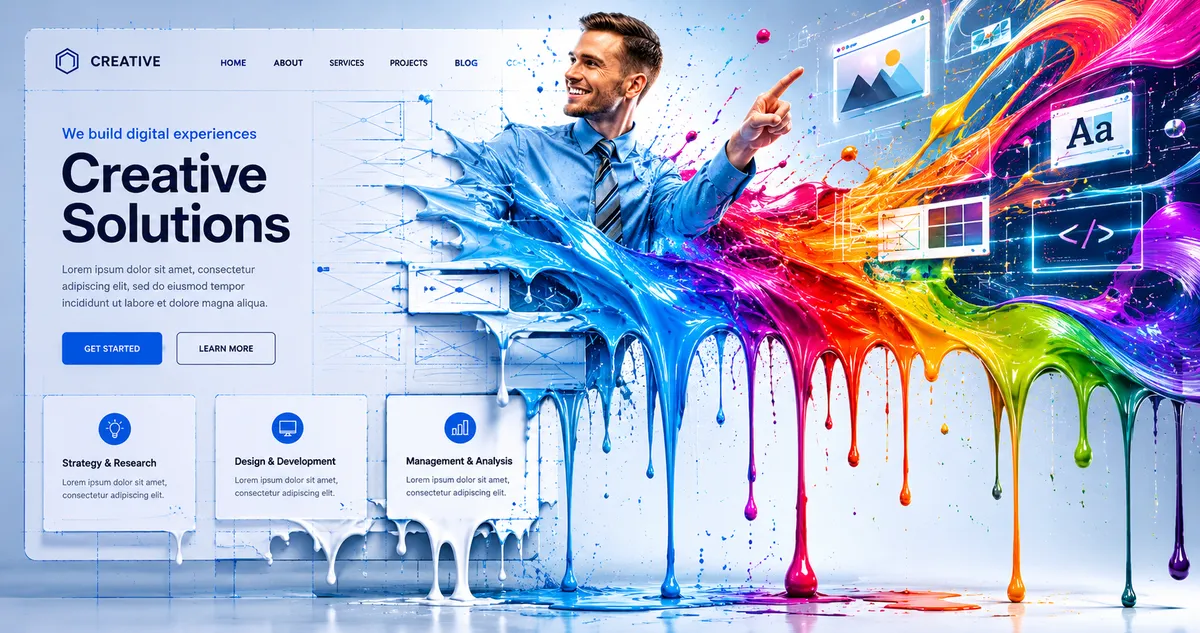
AI is now changing web economics again.
Rather than installing a framework capable of a thousand designs, creators can increasingly generate code for the one design they want. Leaner output. Lower cost. Fewer compromises. Back in the day, web design began in Photoshop. Designers created static images of websites that developers later attempted to reproduce in code. The gap between vision and implementation was expensive. Today, AI can inexpensively map out a designer’s vision before a single line of code is written. Designers can see it first and build from there.
That simple capability has larger implications than it might appear.
For years, creators were forced to fit their ideas into grid templates. Today, they can increasingly fit web design around their ideas. The difference sounds subtle. It changes how websites are conceived.
Instead of asking what template should I use? Creators can begin by asking what experience should visitors have?
One common misconception is that AI replaces artists. In practice, it may often do the opposite.
The Bird Watcher Bernie children's book series, published by Arrow Dot Press, features original artwork by illustrator Rob Ullman. Traditionally, website designers would take finished artwork and force it into the limitations of a template. Images were cropped, resized, reduced, or placed into predefined content blocks because modifying the website code itself was too expensive.
Today, AI makes integrating artwork into a unique visual experience more accessible to users. AI assists in preparing artwork and code assets without the need for a production and programming team. The designer and artist create the vision, and AI becomes an economical extension of the team.
Every website won’t become a Picasso but the artistic and visual expectations of users will increase exponentially. Rather than forcing designs to fit templates, creators can increasingly freeform the website look and feel.
The same shift applies to functionality. Historically, small businesses were limited to whatever features their platform happened to support. Anything more ambitious required hiring developers.
Today, AI helps site owners work with developer tools that would once have been intimidating. Payment integrations, custom navigation, interactive elements, and specialized purchasing experiences are increasingly within reach of small organizations without large budgets. A creator with a basic understanding of websites can use AI to generate, troubleshoot, and refine code that would have required a professional a few years ago.
This doesn't eliminate the need for professional developers. Complex systems still require expertise. But the threshold for what individuals and small organizations can attempt has shifted significantly.
At Arrow Dot Press, where this publication is produced, this shift is shaping several projects in progress.
The Bird Watcher Bernie website is evolving less like a traditional website and more like an illustrated experience. Visual portals and themed navigation allow visitors to explore the world of the StoryDecks, rather than moving through standard menus and pages. The Koalas On Broadway card game site similarly incorporates visual elements drawn from theater and stage design rather than defaulting to a conventional ecommerce layout.
In both cases, fitting into a template doesn’t take over the design. And the website becomes about building an experience.
One unexpected benefit: creators can increasingly separate design from implementation. In the template era, functionality drove design. Businesses worried first about menus, shopping carts, and platform limitations because changing those elements later was expensive. The design came after.
Today, creators are free to design the experience first and implement the mechanics afterward. Once the experience is established, AI-assisted coding makes it far easier to add consistent functional elements like purchasing buttons, checkout flows, and embedded content. Those mechanics no longer dictate the design.
Instead of being constrained by how commerce fits into a template, creators can ask how commerce fits into the experience they want for visitors.
What becomes valuable is the thing templates can't provide: distinctiveness, personality, memorability. A website that feels like it was built for one specific thing, for one specific audience, by someone with a specific vision.
Ironically, artificial intelligence will make the web feel more human. Because AI is radically reducing the cost of customization.
Perhaps future historians of the internet will look back on 2026 as the year the template era began to fade, not because templates disappeared, but because millions of people gained the ability to build something unique.
The web may be returning to its 1998 creative roots.
~David Henson, Citizen Octopus
About the Author
David Henson is an inventor, publisher, writer and founder of Citizen Octopus, a site focused on analyzing systems, incentives, and how information shapes perception.