How Can Elon Musk Say “Big Tech” In OpenAI Trial With a Straight Face?
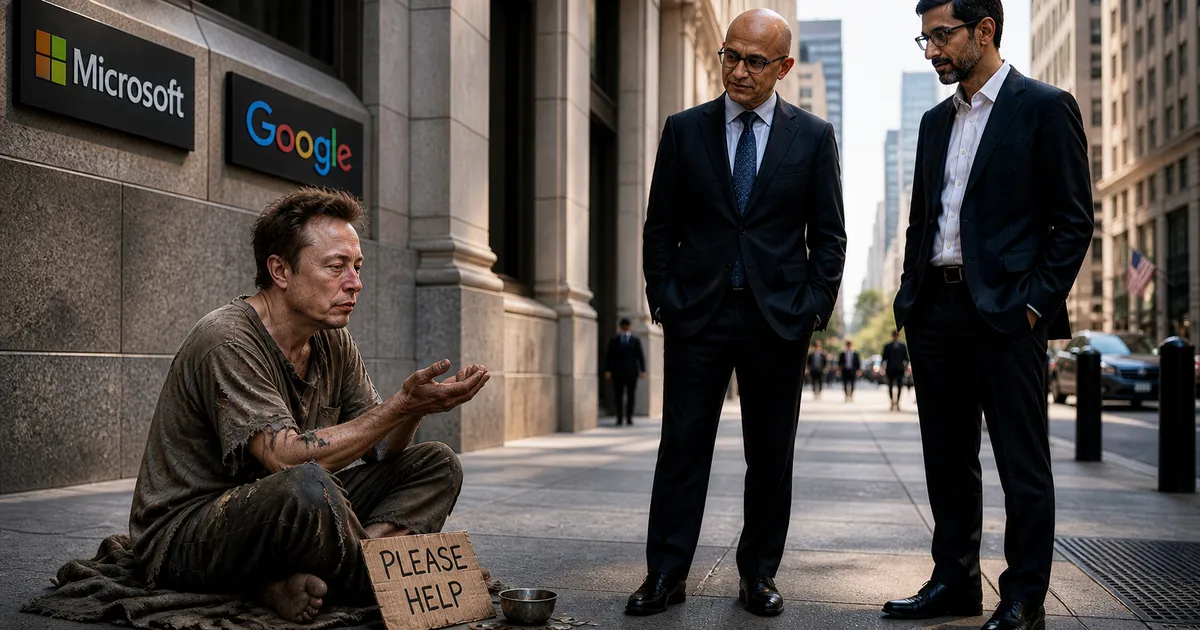
As his trial against OpenAI unfolds, Elon Musk has repeatedly warned about Big Tech and the concentration of power in AI, often pointing to companies like Microsoft and Google.
At first glance, that sounds absurd.
Elon's the richest person in the world (on paper). He runs multiple technology companies. He’s building his own AI firm. If anyone is Big Tech, it’s him.
And yet - he can say it with a straight face.
Because institutionally, he’s not in the same category.
1) Employee Scale: Entire Empires vs Founder Systems
- Microsoft: ~220,000+ employees
- Google (Alphabet): ~180,000+ employees
Musk’s companies:
- Tesla: large (~100k+), but focused on manufacturing
- X: drastically smaller post-acquisition
- xAI: tiny by comparison
Big Tech isn’t just wealth - it’s institutional mass.
Microsoft and Google are global bureaucracies with deep layers of management and continuity.
Musk runs what are essentially high-speed founder-led systems, not sprawling institutional states.
2) Cloud & Compute: The Real Power in AI
This is the most important category and where the gap becomes decisive.
- Microsoft → Azure
- Google → Google Cloud + internal TPU infrastructure + Google DeepMind
These companies:
- own global data centers
- manufacture or design their own AI chips
- deploy compute at planetary scale
Musk (via xAI):
- is building large GPU clusters
- but is still buying into infrastructure others already own
👉 In AI, compute is power and "Big Tech" owns it.
3) Profitability: Cash Engines vs Ambitious Bets
Microsoft and Google generate tens of billions in profit annually
Those profits fund:
- AI research
- acquisitions
- infrastructure expansion
Musk’s companies:
- Tesla is profitable, but cyclical and capital-intensive
- X is not a profit engine
- xAI is pre-profit
So while Musk is wealthy, his system is: resource-constrained relative to Big Tech’s cash flow machines
4) Cash on Hand: Liquidity vs Paper Wealth
This is where the “richest man” narrative breaks down.
- Microsoft and Google each hold ~$100B+ in cash and equivalents
- They can deploy that capital instantly
Musk:
- wealth largely tied up in equity (especially Tesla)
- liquidity requires selling shares or raising capital
- his ecosystem includes leveraged assets (like X)
👉 Big Tech has deployable capital
👉 Musk has concentrated, partially illiquid wealth
5) Institutional Continuity vs Personal Control
Microsoft and Google:
- survive leadership changes
- operate through durable systems
- are embedded in governments, enterprises, and global infrastructure
Musk’s companies:
- are heavily dependent on Musk himself
- move faster but are also more fragile
This is the difference between: a state vs a highly capable individual actor
6) A Note on Bill Gates
It’s also instructive to compare Musk not just to companies, but to figures like Bill Gates.
Gates today:
- has less net worth than Musk
- but much of it is liquid or diversified
- and is deployed through structured vehicles like foundations and investment firms
In practical terms:
Gates may have more flexible capital, even with lower headline wealth
So… Why Can Musk Say “Big Tech”?
Because when Musk says “Big Tech,” he doesn’t mean:
“large technology companies”
He means:
deeply entrenched, massively capitalized, infrastructure-owning institutions
By that definition:
- Microsoft + OpenAI
- Google + Google DeepMind
…are clearly in that category.
Musk, despite his wealth, is operating adjacent to that system, not fully inside it.
The Real Translation
When Musk says “Big Tech,” what he really means is: “The dominant cluster of power that I’m not part of.”
Final Thought
This doesn’t make Musk an outsider.
It makes him something more interesting:
A single individual, however wealthy, trying to break into a club of institutions that already control the infrastructure of the future.
And that’s why Musk calling others “Big Tech” sounds strange but ultimately holds up.
~David Henson | Citizen Octopus
About the Author
David Henson is an inventor, publisher, writer and founder of Citizen Octopus, a site focused on analyzing systems, incentives, and how information shapes perception.