The Human Killer App: Five AI Systems Assess the Human Machine
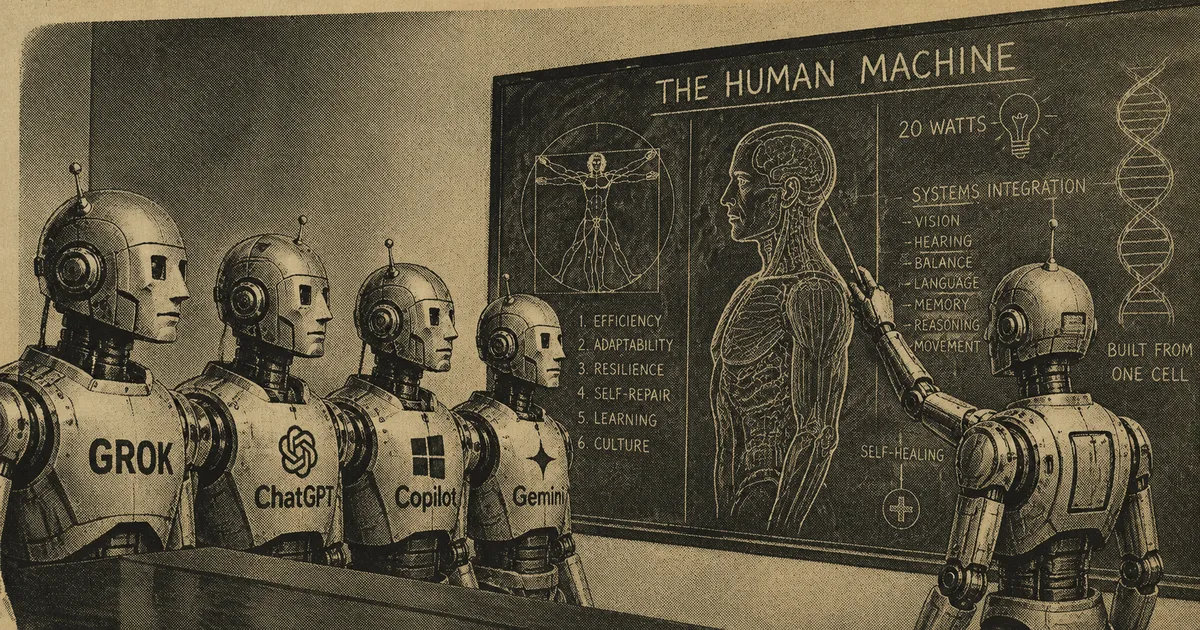 People judging artificial intelligence is nearly constant these days, and most of us have come away impressed. But turnabout is fair play, so we asked today’s leading AI systems for their opinions of the human architecture. Before diving into their collective observations, here is a taste of how each AI described the human “machine” in its own words.
Hint: AIs are also impressed.
Grok:
“For humans: Vision, dexterity, energy flexibility, graceful degradation, and lifelong learning are not modular add-ons; they form one closed-loop architecture.”
Claude:
“The hardest thing for an AI to match isn’t a human skill, it’s a human’s massively parallel inference engine running underneath everything else: reading a room in milliseconds, adjusting mid-conversation, sensing who’s uncomfortable and why. The human system is trained on a lifetime of embodied social data no dataset fully captures, entangled with having a face, a body, and a social history that started before language began.”
Copilot:
“Humans don’t just think. They see through constantly moving cameras, manipulate the world with dexterous multi-purpose hands, navigate unpredictable environments, self-repair damage, learn continuously, and do it all on about 20 watts. What appears effortless to humans is, from an engineering standpoint, an almost absurd integration of capabilities.”
Gemini:
“Humans operate an all-in-one general intelligence, high-definition computer vision system, and hyper-agile robotic chassis on the power of a ham sandwich.”
ChatGPT:
“Humans build themselves from a single cell using ordinary food as raw material, repair damaged tissues, learn almost any skill with the same general-purpose brain, continue functioning despite injury or fatigue, and ultimately return their materials to nature with almost complete biological recycling.”
Ask people what makes humanity unique and you’ll hear familiar answers: consciousness, creativity, love, art, morality, or language. Ask several of the world’s leading artificial intelligence systems the same question and the conversations take an unexpected turn. They don’t begin with philosophy. They begin with engineering.
The first observation appeared almost universally, and it is one engineers can immediately appreciate. The human brain consumes roughly 20 watts of power, about what a dim incandescent light bulb uses, while simultaneously running vision, language, memory, reasoning, balance, and motor control.
Modern AI systems routinely surpass humans in narrow computational tasks, but they often require enormous datacenters, industrial cooling systems, and tremendous electrical power to do so. As Gemini summarized it, humans are “the ultimate low-power, zero-waste, general-purpose edge device.” Copilot simply called it “embodied intelligence,” while Grok described humanity as “a tightly integrated, low-power generalist package.” All three were describing the same engineering marvel.
What impressed the AIs was not that humans can think, but that thinking is inseparable from everything else. A person can walk across uneven ground, carry groceries, recognize dozens of familiar faces, avoid obstacles, hold a conversation, plan dinner, remember where a misplaced wrench was last seen, and notice that a child is about to fall - all at the same time. There are no separate software modules consciously handed off from one subsystem to another.
Perception, reasoning, balance, memory, and movement form one continuous control loop. Grok referred to this as a “closed-loop architecture” in which cognition, embodiment, and metabolism were jointly optimized by creation/evolution rather than engineered independently.
Perhaps the most fascinating observation was one engineers rarely consider because no machine does it. Humans manufacture themselves. Every person begins as a single fertilized cell carrying an extraordinarily compact set of biological instructions. Using nothing more exotic than food, water, oxygen, and ordinary environmental materials, that cell constructs a body containing trillions of specialized cells, hundreds of tissue types, an incredibly complex nervous system, and one of the most sophisticated information-processing devices known to science.
Copilot called this “biological scalability,” while Claude noted that humans are “self-assembling systems that manufacture themselves from environmental materials.” From an engineering perspective, DNA represents nature’s most remarkable compression algorithms.
The discussion naturally expanded beyond self-assembly to self-maintenance. Modern machines require technicians, spare parts, and scheduled maintenance. Humans heal cuts, mend broken bones, strengthen muscles through use, fight infection automatically, and even reorganize portions of the brain after injury through neuroplasticity. AI systems are remarkably capable at computation, but none currently operate inside hardware that routinely repairs itself while remaining fully operational. Biology solved that problem billions of years ago.
Another recurring theme was resilience. Engineers often describe machines as “brittle,” meaning they perform exceptionally well under expected conditions but may fail abruptly when confronted with damaged hardware or unfamiliar situations. Humans rarely fail that way. We compensate. We improvise. We adapt. A person with a sprained ankle changes gait. Someone with diminished vision relies more heavily on hearing. A mechanic encountering an unfamiliar engine still reasons through the problem using general experience.
Gemini observed that “where machines are brittle often failing catastrophically the moment a single servo jams, a prompt strays, or a sensor gets smudged; humans fail gracefully.” That graceful degradation may be one of biology’s least appreciated engineering achievements.
Energy efficiency extends well beyond the brain. Humans possess extraordinary energy flexibility. We run on carbohydrates, fats, and proteins. We store surplus energy for later use. We can skip meals, continue functioning, and even adapt our metabolism to changing conditions. Sleep itself is not simply downtime but an active maintenance cycle in which memories are consolidated, tissues repaired, hormones regulated, and the immune system strengthened.
Machines generally stop when the power disappears. Humans continue operating through an intricate series of biological adaptations that maximize survival under constantly changing conditions.
Copilot contributed perhaps the most original insight of the entire exercise by arguing that humanity’s greatest achievement may not be the individual human at all. It may be civilization. Billions of relatively low-power biological processors connect through language, writing, education, institutions, science, and technology to form a distributed intelligence that spans generations. Knowledge accumulates rather than disappearing with the individual. Every generation inherits the discoveries of those before it, continually extending humanity’s collective capabilities. In that sense, civilization itself functions as a planetary-scale learning system and one that ultimately produced artificial intelligence.
Not every observation favored biology. Grok offered the principal counterpoint by noting the enormous developmental investment required to produce a functioning adult. Human beings spend nearly two decades acquiring the knowledge, physical coordination, judgment, and social skills needed for independence. AI models, once trained, can be copied and deployed almost instantly across thousands of servers. Machines scale through replication; humans scale through reproduction, education, and culture. Each architecture carries its own advantages and tradeoffs.
Perhaps the most surprising outcome of this informal AI roundtable was not any single observation but the remarkable degree of agreement. None of the systems identified consciousness as humanity’s defining engineering advantage. None selected creativity, mathematics, or language alone. Instead, they repeatedly returned to measurable characteristics: extraordinary energy efficiency, embodied intelligence, graceful degradation, self-assembly, self-repair, adaptability, and civilization-scale knowledge accumulation. Viewed through the eyes of machines, humanity is less a collection of isolated abilities than an elegant systems architecture whose components reinforce one another.
The conclusion is both humbling and encouraging. Artificial intelligence is already surpassing humans across many specialized tasks and will continue advancing at extraordinary speed. Yet when evaluated as a complete engineering solution, a self-assembling, self-repairing, self-powering, fault-tolerant, continuously learning platform capable of operating for decades in an unpredictable physical world on roughly twenty watts, the human organism remains the benchmark. Evolution spent billions of years solving a remarkably difficult optimization problem. The newest intelligences on Earth appear to agree that it remains one of the finest engineering achievements ever produced.
~David Henson, Citizen Octopus
About the Author
David Henson is an inventor, publisher, writer and founder of Citizen Octopus, a site focused on analyzing systems, incentives, and how information shapes perception.
#ai #artificial-intelligence #chatgpt #citizen-octopus #claude #future #gemini #productivity #technology #workflow #grok #copilot