Iran Didn’t Fail, It Stalled. America Should Deal With the Builders
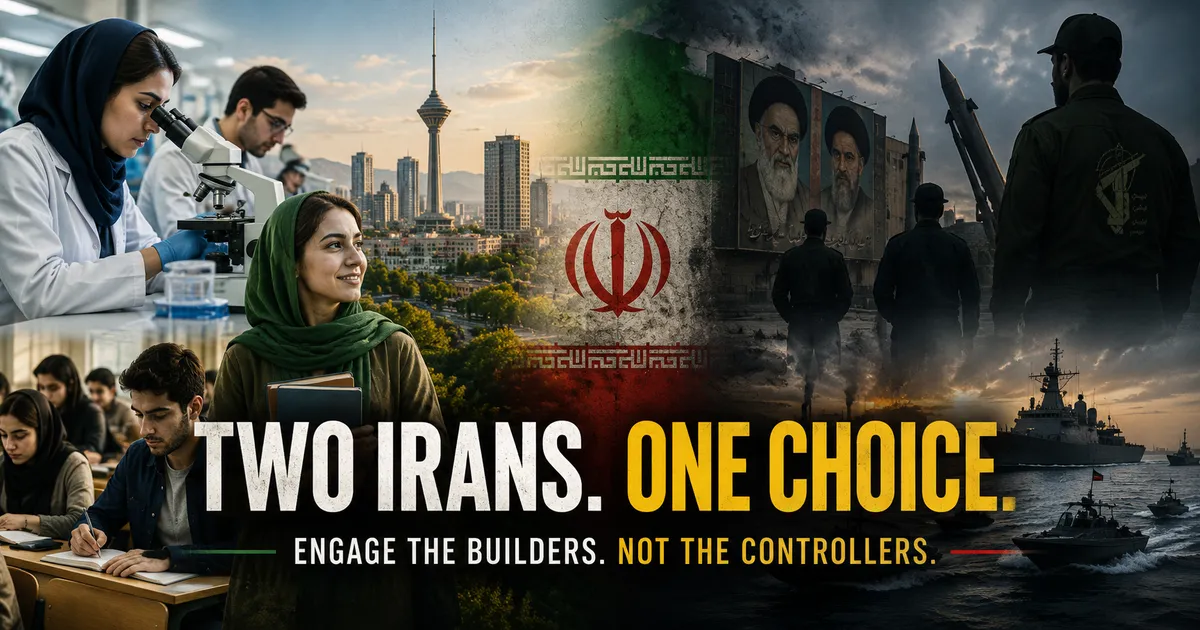 Americans are used to hearing one story about Iran: a hostile regime, a bad actor, a problem to contain.
That story isn’t wrong. But it’s incomplete and that matters, because incomplete thinking leads to bad policy.
The truth is simpler and more uncomfortable:
Iran didn’t just break things. It built things too.
What Iran Actually Got Right
Over the past few decades, Iran has:
- taught nearly its entire population to read
- built a real healthcare system, including in rural areas
- produced millions of engineers, doctors, and scientists
That’s not propaganda. Those are real outcomes.
Iran today is not an uneducated or incapable society. It’s the opposite.
It is a country full of people who can build, solve problems, and run complex systems.
Iran Matters — And It’s Worth Getting Right
Iran isn’t some isolated country we can ignore.
- It sits next to the Strait of Hormuz, where roughly 20% of global oil flows
- What happens there affects gas prices, inflation, and the global economy
And beyond geography:
- Iran is an ancient civilization
- It has a highly educated population
- It has already shown it can build real systems under pressure
This is a serious country with serious people.
Which means getting policy right actually matters.
The Real Problem Isn’t Capability — It’s Direction
Iran has the pieces:
- educated citizens
- functioning institutions
- technical talent
But it also has:
- an economy that doesn’t fully use that talent
- policies that isolate the country
- a system that often rewards control over creation
So the question isn’t whether Iran can succeed.
The question is:
Which part of Iran gets to lead?
There Are Two Irans
You can see it clearly.
The builders
- teachers
- doctors
- engineers
- scientists
The controllers
- security apparatus
- hardline power structures
- groups focused on survival and leverage
Right now, the second group dominates.
And that’s the core problem.
What America Should Actually Do
The U.S. cannot pick Iran’s leaders.
But it can decide how it engages.
So the strategy should be simple:
- Maintain the current pressure
- But change who we’re willing to deal with
Engage seriously with the parts of the system that actually work:
- healthcare
- education
- science
Make it clear:
If progress happens there, it gets rewarded. If it doesn’t, nothing changes.
What We Should Not Do
Don’t rush into a deal just to get a deal.
Especially not one that:
- strengthens the most ruthless parts of the system
- ignores the parts that actually build the country
- trades long-term stability for short-term headlines
That’s not diplomacy. That’s impatience.
The Message to Washington
Be patient.
The United States has the ability to sustain pressure over time. It doesn’t need to settle for a weak agreement.
A bad deal with the wrong people doesn’t solve the problem — it locks it in.
The Real Opportunity
Iran has already proven it can build a capable society.
That’s not the issue.
The issue is whether that capability is allowed to lead.
The smartest path forward isn’t tearing the system down or pretending it will fix itself.
It’s this:
Reward the part of Iran that builds, not the part that only survives.
Closing
Iran is not just a problem to manage.
It’s a country that has already shown what it can do.
Don’t ask whether Iran can succeed. Ask which part of Iran we’re choosing to engage.
~David Henson | Citizen Octopus
About the Author
David Henson is an inventor, publisher, writer and founder of Citizen Octopus, a site focused on analyzing systems, incentives, and how information shapes perception.