What If Ukraine Doesn’t Join the West, But Replaces Russia?
A thought experiment on power, identity, and the future of the East Slavic world
June 23, 2026 By David Henson | Citizen Octopus
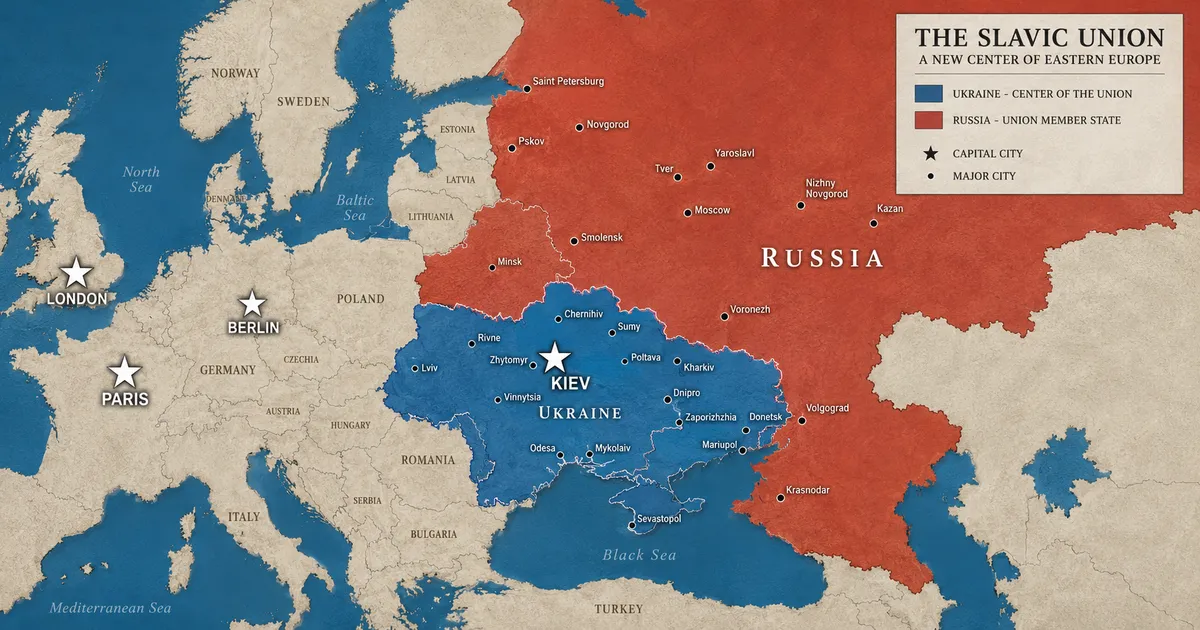 Most discussions about the war in Ukraine assume roughly the same ending. Ukraine survives, joins Western institutions, enters the European Union, deepens its relationship with NATO, and gradually becomes another European nation-state integrated into the Western order.
But what if that assumption is wrong?
What if Ukraine’s ultimate ambition is not to join the West, but to become something larger than a Western client state? What if a decisive Ukrainian victory leads not to Ukraine becoming part of the West, but to Ukraine becoming the dominant political center of the East Slavic world?
At first glance, the idea sounds wild. Yet history is full of political transformations that seemed impossible right up until the moment they happened. The question is not whether Ukraine could conquer Russia, it cannot. The question is whether a victorious Ukraine could become the state that Russians themselves look toward for leadership.
The Forgotten Possibility
Most analysts default to a narrow set of outcomes: Russia wins and dominates Ukraine; Ukraine wins and joins The West; or the conflict freezes until a new government emerges in Moscow. What receives almost no attention is the possibility a Ukrainian victory could fundamentally alter the balance of prestige between the two nations.
For centuries, Moscow has been regarded as the center of Russian civilization, while Ukraine was often portrayed as peripheral. The war has already begun to challenge that assumption. Ukraine has demonstrated military resilience, organizational competence, and national determination that few observers expected. Regardless of how the war ends, it has already shifted how much of the world perceives Ukrainian capability.
Success changes how nations understand themselves. A Ukraine that defeats a larger neighbor may not see itself as a future Western province. It may begin to see itself as a future world power.
Why Join Someone Else’s Civilization?
The dominant Western narrative assumes that Ukraine’s highest aspiration is membership in Western institutions. Many Ukrainians may agree, for now. But Ukrainians in the future may ask a different question:
Why should Ukraine define success as joining somebody else’s club?
Why should a nation that survived one of the defining wars of the twenty-first century aspire merely to become a medium-sized European state?
Victorious nations rarely think that way. They expand their horizons rather than narrow them. Rather than imagining itself as Europe’s frontier, Ukraine could begin to see itself as the center of a broader civilization.
Ukraine is not simply between Russia and Europe.
Ukraine is Europe.
Ukraine is Slavic civilization.
Ukraine is a state with its own historical trajectory and destiny.
The Confidence of Victory
The decisive factor in this thought experiment is not victory alone, but the manner in which it is achieved. Throughout the war, Western support has often arrived with conditions, delays, and fears of escalation. Washington, Berlin, Paris, and Brussels have sought to help Ukraine without provoking a wider conflict.
Their caution is understandable but not necessarily aligned with Kyiv’s ambitions.
Imagine a point at which Ukraine concludes that Western caution has become the principal obstacle to victory. Rather than waiting for permission, Kyiv expands its own military-industrial base, pioneers new methods of warfare, and increasingly acts on its own judgment.
The details matter less than the outcome:
Ukraine wins on terms defined primarily by Ukrainians rather than Western capitals.
That distinction reshapes national psychology. A country that believes it was saved by others tends to become a partner. A country that believes it saved itself begins to ask why it should follow anyone at all.
The lesson drawn in Kyiv would not be that Ukraine needs the West.
It would be that Ukraine possesses the capacity to chart its own course.
Russia’s Alternative
Western discussions often assume that a defeated Russia would collapse, isolate itself, or attempt slow integration with Western institutions. But Russians might reach a very different conclusion.
If forced to choose between permanent subordination to Western influence and partnership with a powerful Ukraine, some Russians might eventually see the latter as preferable.
“We lost to Kyiv, not Washington. We remain part of the same cultural family. Our future lies in rebuilding with Ukraine, not in dependence on distant powers.”
This would not require Russians to abandon their identity, nor Ukraine to govern Russia. Instead, it could take the form of partnership; federation, confederation, or strategic alignment based on the idea that the two nations are stronger together than apart.
The Bilingual Republic
Paradoxically, Ukraine’s path to leadership might require reversing some of its wartime instincts. Today, Ukraine is strengthening its distinct identity, reducing Russian-language influence across public life.
Under current conditions, this is entirely understandable.
But a Ukraine seeking leadership of the East Slavic world would eventually take a different approach. Rather than treating Russian as the language of an adversary, Kyiv could position itself as the home of free Russian-language culture.
Imagine Russian journalists, writers, academics, entrepreneurs, and dissidents choosing Kyiv over Moscow. Imagine Russian-language publishing flourishing in Ukraine while facing repression in Russia.
In that world, Kyiv would not simply be Ukraine’s capital.
It would become the intellectual capital of the entire Russian-speaking world.
The irony would be profound:
The center of Russian-language culture would no longer be Russia.
A New Eastern Order
A battle-tested Ukraine could emerge with the most experienced army in Europe and it is armies, not institutions, that ultimately anchor regional orders.
The West tends to imagine Ukraine as a future security consumer. A victorious Ukraine could instead become a security provider. Rather than seeking shelter beneath existing structures, Kyiv could become the state around which new structures form.
The Spiritual Question
Political leadership alone is not enough. Durable civilizations require cultural and spiritual legitimacy as well.
Moscow has claimed a special role as the center of the Orthodox East Slavic world. The war places that claim at risk. A church that blesses a disastrous war weakens its authority; a victorious society strengthens its own.
The result is straightforward: Kyiv reclaims its historical position as a spiritual center of East Slavic Christianity, while Moscow becomes increasingly associated with an imperial project that failed.
Political authority follows military success.
Cultural authority follows political authority.
Spiritual authority follows cultural authority.
If Moscow loses militarily, Kyiv can eventually acquire all three.
Russia’s New Direction Moment
The strongest argument for this thought experiment is psychological. Nations often struggle less with defeat itself than with who defeats them.
A defeat imposed by Washington would fuel resentment.
A defeat imposed by Kyiv forces something deeper.
It forces comparison.
A future Russian reform movement could look outward and conclude:
Modernization does not require becoming Western. It requires becoming successful.
In that case, Ukraine would not merely be the victor.
It would be the model.
The Kyiv Succession
The most provocative possibility is that Ukraine’s greatest victory would not be territorial.
It would be psychological.
For centuries, Moscow was assumed to be the center and Kyiv the periphery. What if the war reverses that hierarchy?
What if Kyiv becomes the place that projects confidence, attracts talent, and offers the more compelling vision of the future?
If that happens, Russia’s long-term challenge will not be resisting Ukraine.
It will be deciding how closely it wants to align with it.
The Paradox of Success
The ultimate irony is that for Ukraine to lead the East Slavic world, it may have to stop defining success as escaping it.
Today, Ukraine’s strategy is oriented westward. Its survival depends on Western support.
But a victorious Ukraine could face a different question: Is its destiny to be absorbed into the Western system? Or to become a pole of power in its own right?
Perhaps Ukraine’s ultimate victory would not be joining the West.
Perhaps it would be becoming a civilization the West must engage on its own terms.
Modern readers assume that legitimacy cannot cross borders, that identities are fixed, that political centers are permanent. European history suggests otherwise. Power shifts. Centers move. Civilizations reorganize.
The assumption that Moscow must always lead the East Slavic world is not a law of history.
It is simply a habit of thought.
Russians and Ukrainians share language, history, and cultural understanding. Ukraine has already demonstrated that an East Slavic nation can build a more adaptive and accountable system than the one that emerged in Moscow.
That creates a different kind of possibility:
“The choice is not Russia or the West. The choice is Moscow’s old model or Kyiv’s new model.”
That is a far easier transition to imagine than becoming something entirely foreign.
The West may ultimately be overestimating the importance of formal institutions while underestimating a quieter transformation already underway:
People may already be imagining futures that do not fit existing geopolitical categories.