Will You Need AI for Your AI?
 Not long ago, people asked: Will artificial intelligence become useful?
Today the question has changed: Which AI should I use?
But many of us are already living the next phase.
The real question, even now, is: How do I use multiple AIs without losing control of my project?
The first generation of AI users hunted for the single smartest chatbot. They compared benchmarks and debated which model wrote better prose, generated cleaner code, or reasoned more effectively.
That race is becoming less interesting.
As someone who regularly uses ChatGPT, Claude, Gemini, Grok, and Copilot, I’ve found they are all remarkably capable. More importantly, they approach the same problem from different angles. One catches a logical flaw. Another suggests a clearer explanation. A third challenges an assumption I didn’t notice. Occasionally one produces an insight that changes the direction of the entire project.
When the stakes are high, a patent application, an important contract, a published article, or a business proposal, it often makes sense to seek multiple independent perspectives.
The problem is no longer finding intelligence. The problem is organizing it.
Here’s what that looks like today.
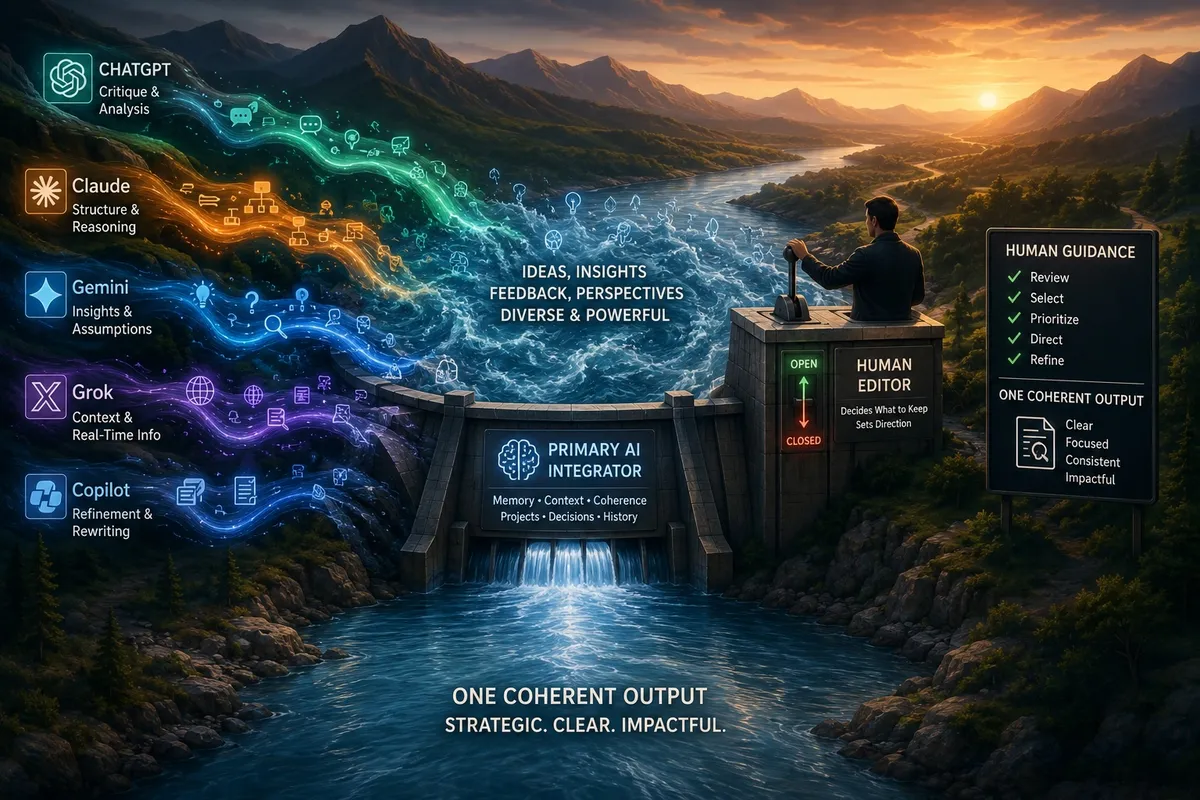
Suppose I’m writing an article. I might ask one AI to critique the draft, another to surface hidden assumptions, a third to play devil’s advocate, and a fourth to evaluate whether the argument would persuade someone who disagrees with me.
Soon I have thoughtful reviews, conflicting recommendations, and a collection of fresh ideas.
At this point, I don’t blindly merge everything. I read every response myself.
Some suggestions are redundant. Some miss the point entirely. Some would weaken the article. But every so often one AI contributes an idea that genuinely improves the work. Those are the ideas I keep.
Then I return to my primary AI, the one I’ve chosen to maintain the institutional memory of the project, and say something like: “I’ve reviewed feedback from several AI systems. These are the ideas I want to incorporate. Weave them naturally into the article, preserve my voice, eliminate redundancy, and make sure the finished piece still reads as though it was written by one author with one coherent argument.”
That primary assistant isn’t replacing my judgment. It is amplifying it.
The human remains the editor. The primary AI becomes the integrator.
Its job isn’t to decide what I believe. Its job is to remember where the project has been, understand where I want it to go, and help transform selected ideas into one coherent piece of work.
This isn’t a prediction for some distant future. It’s a workflow that’s already emerging among people who regularly use multiple AI systems.
The pattern is surprisingly simple: Diverge for ideas. Converge for execution.
Most people imagine the future as a competition where one AI defeats all the others. I suspect the opposite is already happening. The advantage belongs to people who use one AI as their chief of staff while drawing on other AIs as specialized consultants.
There is another reason this model matters.
As AI becomes more capable, many of us will subscribe to multiple services. The challenge won’t be the monthly subscription cost. The challenge will be preventing our work from becoming scattered across conversations, platforms, and fragmented memories. Without a deliberate primary AI, remarkable intelligence can quickly become remarkable clutter.
Every serious project develops a history. Every article has earlier drafts. Every patent evolves through multiple revisions. Every business accumulates conversations, decisions, experiments, and lessons learned.
Someone, or something, must preserve that institutional memory.
I increasingly rely on one AI as my long-term assistant. Not necessarily because it is the smartest in every category, but because it understands my projects, my writing style, my previous decisions, and where my thinking has already been.
The other AIs become trusted specialists. The primary one keeps everything coherent. Artificial intelligence is becoming abundant. Human attention is not.
The next breakthrough may not be another AI model.
It may be learning how to orchestrate many intelligent systems without losing a coherent line of thought.
~David Henson, Citizen Octopus
About the Author
David Henson is an inventor, publisher, writer and founder of Citizen Octopus, a site focused on analyzing systems, incentives, and how information shapes perception.