The Vikings May Discover They Already Had Their Franchise Quarterback
June 2, 2026 By David Henson | Citizen Octopus
The debate surrounding the Minnesota Vikings quarterback room misses the real story.
The real question is not whether Kyler Murray can win football games.
The real question is whether Minnesota is willing to risk overlooking a potential franchise quarterback because his early statistics fail to tell the entire story.
NFL history offers a cautionary tale. In 1991, the Atlanta Falcons drafted a raw, strong-armed quarterback named Brett Favre. After seeing little immediate return, they traded him after just one season. The Green Bay Packers saw something different. They saw traits worth developing. Favre would go on to become a Hall of Famer and one of the defining quarterbacks of his generation.
J.J. McCarthy may never become Brett Favre. Few quarterbacks do.
But the underlying metrics that often precede elite quarterback play: rare arm talent, exceptional big-time throw production, aggression, and a willingness to attack difficult areas of the field are already present. The Vikings are not deciding whether McCarthy is currently better than Kyler Murray. They are deciding whether those traits are worth developing.
Minnesota faces an organizational challenge: determining whether elite quarterback traits deserve patience.
Kyler Murray arrives with an impressive NFL résumé. He remains one of football's most gifted improvisational players, capable of creating offense when structure breaks down. At his best, he is electric. His athleticism and instincts helped make him one of the most celebrated high school football players in Texas history, and he has proven he can win games in the NFL.
When healthy, Murray keeps teams competitive.
The problem is that NFL franchises are not built around simply staying competitive.
They are built around finding quarterbacks capable of carrying a championship-caliber roster for a decade.
That is where the Vikings’ decision becomes fascinating.
At first glance, McCarthy’s 2025 numbers appear modest. He finished with 1,632 passing yards, 11 touchdowns, and 12 interceptions as Minnesota posted a 9-8 record.
Those are not franchise-quarterback statistics.
Yet some of the most important underlying metrics paint a very different picture.
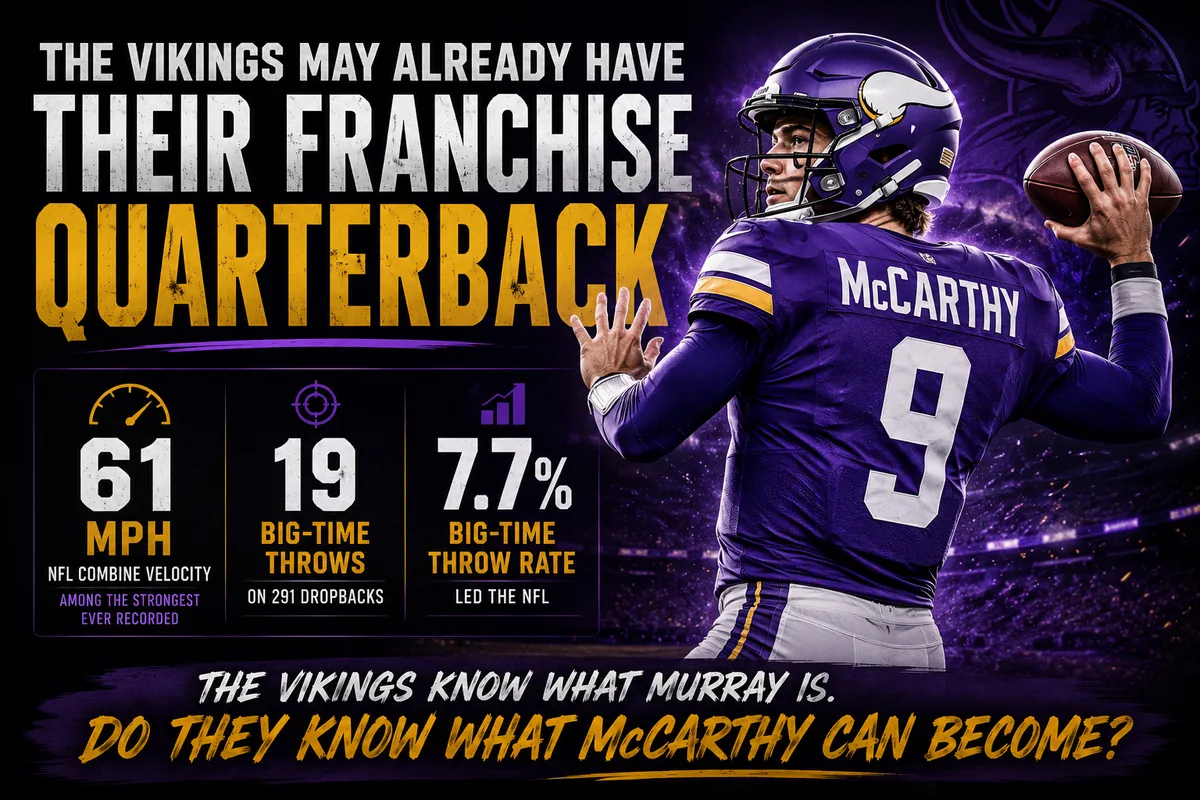
Despite missing his true rookie season with a meniscus injury, McCarthy finished his first playing season with 19 big-time throws on only 291 dropbacks. By December, his big-time throw rate sat between 7.2% and 7.7%, leading the entire NFL and at times surpassing established veterans such as Matthew Stafford.
Those numbers matter because big-time throws are not accidental.
They represent the ability to see, attempt, and complete difficult NFL passes that many quarterbacks simply cannot make.
You cannot teach a quarterback to possess elite arm talent.
You cannot teach a quarterback to suddenly see tight-window opportunities thirty yards downfield.
You cannot teach a quarterback to attack every blade of grass on the field.
You can, however, teach him when not to do it.
And that is exactly what makes McCarthy so intriguing.
At roughly 6-foot-3, armed with a 61 mph throwing velocity that ranks among the strongest ever recorded at the NFL Combine, McCarthy possesses the physical traits NFL organizations have spent decades searching for.
More importantly, those traits have already shown up in actual games.
His late-season performance against Dallas offered a glimpse of what that ceiling might look like. McCarthy generated four big-time throws in a single game, earning an elite 89.7 PFF grade and a stellar 142.4 passer rating on throws past the sticks. The tape backed up the numbers: a 20-yard touchdown strike to Jalen Nailor while on the move, a 58-yard bomb to Jordan Addison after escaping pressure from Jadeveon Clowney, and a 29-yard seam throw to T.J. Hockenson that Kevin O'Connell later called "a spectacular throw."
Those are not the kinds of throws typically associated with future career backups.
Of course, there is another side to the story.
McCarthy’s season was also defined by mistakes.
Alongside 19 big-time throws came 15 turnover-worthy plays, resulting in a high-risk 5.2% turnover-worthy play rate. He held the football for an average of 3.01 seconds, one of the longest times-to-throw in the league. He absorbed 27 sacks while repeatedly searching for explosive plays rather than taking the easy completion.
In many ways, McCarthy’s statistical profile can be summarized in one word: aggression.
He hunts big plays on nearly every dropback. That aggressiveness produced spectacular plays. It also produced turnovers, sacks, and frustration.
Kyler Murray represents almost the opposite philosophy.
While it is true that Murray reached an elite 8.0% big-time throw rate during his outlier 2021 season in Arizona, his multi-season career baseline tells a much more conservative story. Over his career, Murray’s big-time throw rate averages 4.1%. In his injury-shortened 5-game stretch prior to joining Minnesota, that number cratered to a low 2.1%, yielding just 4 big-time throws on 195 dropbacks.
Yet, over the last several seasons, Murray has evolved into a far more mature and controlled quarterback. Rather than constantly forcing difficult downfield throws, he has become an incredibly protective distributor, pairing his lower depth of target with an exceptionally safe 1.6% turnover-worthy play rate. He gets the ball out faster than McCarthy at 2.81 seconds, using his mobility as a complement rather than the foundation of his game.
Murray is calculated.
McCarthy is explosive.
Murray protects possessions.
McCarthy attacks defenses.
And that distinction reveals the real question facing Kevin O’Connell. The decision is not about arm strength. It is not about experience. It is not even about who gives Minnesota the best chance to win in September.
It is about what type of offense the Vikings want to become.
If O’Connell wants a quarterback who protects the football, minimizes mistakes, and efficiently distributes to Justin Jefferson, Jordan Addison, and T.J. Hockenson, Murray is the safer option. If he wants an offense built around explosive downfield aggression and vertical pressure, McCarthy becomes the obvious choice.
Some will argue that the prudent path is to let McCarthy sit and learn.
Historically, however, the quarterbacks who become franchise cornerstones do so by playing. Young, high-variance talents like Josh Allen or Trevor Lawrence put up remarkably similar high-aggression, high-turnover statistical profiles early in their careers before live repetitions ironed out the wrinkles.
Live NFL reps matter. Learning when to throw the ball away matters. Learning when not to challenge double coverage matters. Learning how quickly NFL pass rushers close windows matters.
Those lessons cannot be fully learned from the sideline.
For McCarthy to become a true franchise quarterback, three areas of development stand out: First, he must speed up his internal clock. Dropping his average time-to-throw from 3.01 seconds into the 2.65-to-2.75 range would dramatically reduce unnecessary sacks. Second, he must learn the value of the “good” throwaway. A ball launched harmlessly into the third row on second-and-ten is often a winning play. Third, he must improve his pocket navigation and eliminate blind-side sacks that turn manageable downs into drive-killers.
None of those corrections require less arm talent.
They require experience.
The encouraging sign is that McCarthy already showed growth late in the season. Over his final four games, he posted a 100.4 passer rating, completed 64.3 percent of his passes, accounted for seven touchdowns against only three turnovers, and led Minnesota to four straight victories. That looks less like a quarterback surviving and more like a quarterback beginning to figure things out.
Which brings us back to the central question.
Kyler Murray may help the Vikings win nine or ten games.
He is good enough to do that.
But Minnesota already knows what that outcome looks like.
What they do not know is whether McCarthy can become a tier-one quarterback. They do not know whether the league-leading big-time throw rate, the elite velocity, the prototype frame, and the flashes of extraordinary downfield passing are the early signs of something special. And there is only one way to find out.
At some point, the Vikings must stop asking whether McCarthy is ready, and start asking whether they are ready to get out of their own way and develop a quarterback who could be an elite thrower for decades.
Because if those flashes are real, Minnesota’s search for a franchise quarterback may already be over.
~David Henson, Citizen Octopus
About the Author
David Henson is an inventor, publisher, writer and founder of Citizen Octopus, a site focused on analyzing systems, incentives, and how information shapes perception.